
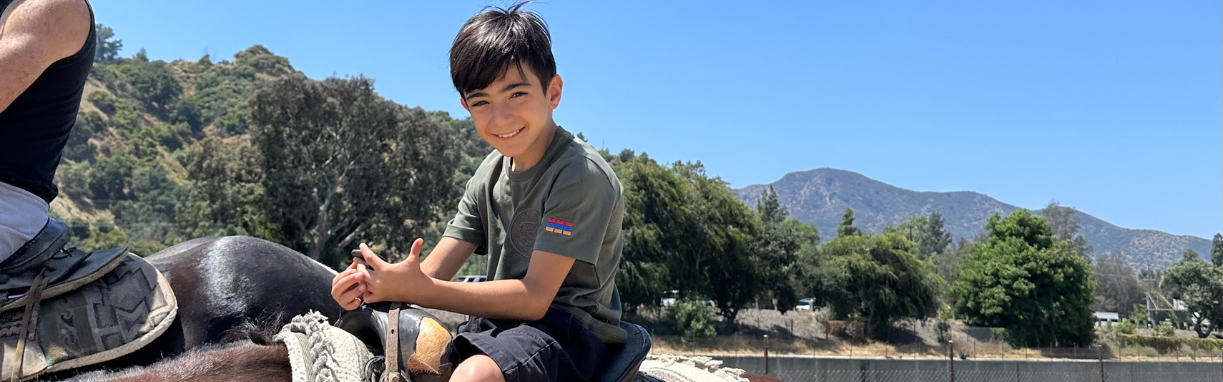
Why Therapeutic Riding Has Been Life-Changing for Alex
By Nina Garayan, Esq
There are certain therapies you try because a professional recommends them.
And then there are the ones that stay in your life because you see the difference with your own eyes.
For our family, horseback riding has been one of those life-changing experiences.
Alex has been riding horses since he was just two years old. At first, it was simply something we wanted to explore — another way to support his development, another opportunity for connection. But over the years, horseback riding has become something much deeper. It is one of the places where Alex feels strongest, calmest, and most joyful.
Every single time he finishes a riding session, I see it. His body is more organized. His mood is lighter. He is regulated. He is proud. And as a mother, that shift is something I will never take for granted.
As both a parent and an advocate, I believe in combining lived experience with evidence. And what we have experienced with Alex is supported by a growing body of research on therapeutic horseback riding for children with autism.
Therapeutic horseback riding — often referred to as hippotherapy or equine-assisted therapy — is a structured intervention that uses the natural movement of a horse to address physical, sensory, emotional, and social goals.
The horse’s gait closely mimics the human walking pattern. When a child sits astride a moving horse, their body is gently challenged to adjust, balance, and respond in real time. This activates core muscles, stimulates the vestibular system (balance and movement), and provides rich proprioceptive input (body awareness).
Organizations such as PATH International have established safety and training standards for equine-assisted services, helping ensure that programs are delivered by qualified professionals with therapeutic intention.
The benefits of therapeutic horseback riding for children with autism have been studied for more than a decade, and the results are encouraging.
One of the most influential studies in this area is a 2014 randomized controlled trial conducted by Gabriels and colleagues and published in the Journal of the American Academy of Child & Adolescent Psychiatry. This study found that children with autism who participated in therapeutic horseback riding demonstrated:
- Significant improvements in social communication
- Increases in the number of words spoken
- Reductions in irritability
- Decreases in hyperactivity
Because this was a randomized controlled trial — the gold standard in research design — it carries substantial weight in the scientific community.
Earlier, in 2012, Bass, Duchowny, and Llabre published findings in Research in Autism Spectrum Disorders showing that children who engaged in therapeutic horseback riding experienced improvements in social responsiveness and sensory processing behaviors compared to control groups.
In 2018, Borgi et al., publishing in International Journal of Environmental Research and Public Health, reported that equine-assisted interventions were associated with improved social functioning, emotional regulation, and reductions in certain maladaptive behaviors.
Systematic reviews indexed through the National Institutes of Health conclude that while larger studies are still needed, current evidence suggests that equine-assisted therapy may positively influence adaptive behaviors, social skills, and emotional regulation in children on the autism spectrum.
This matters. Because when research aligns with lived experience, we begin to see a fuller picture.
Why Horses Can Be So Regulating for Autistic Children
To understand why horseback riding can be so impactful, we need to look at the nervous system.
Many autistic children experience differences in sensory integration. Their bodies may struggle to process vestibular input (movement and balance), proprioceptive input (body awareness), and tactile sensations in predictable ways. Therapeutic riding provides all three — rhythmically and consistently.
The steady, repetitive movement of the horse provides predictable vestibular stimulation. Research in sensory integration suggests that rhythmic input can help regulate the autonomic nervous system — the system responsible for stress and calm responses.
When Alex rides, his body is moving in a patterned, organized way. That rhythm appears to calm his system from the inside out.
Balancing on a horse requires constant micro-adjustments in posture and muscle engagement. This strengthens the core and improves coordination. Proprioceptive input is often described as “organizing” for the nervous system — and many occupational therapy programs intentionally incorporate activities that mimic this kind of deep body engagement.
Horses are deeply intuitive animals. They respond to subtle changes in body language and emotional state. For many autistic children, interacting with a horse removes the social complexity that can come with human relationships. There is no pressure for eye contact. No confusing facial cues. Just presence and response.
That bond builds confidence.
What I See in Alex
I don’t just read studies — I watch my son.
On riding days, Alex is engaged in a way that feels authentic and self-driven. He gives commands. He sits tall. He focuses. When he dismounts, there is a visible sense of accomplishment.
He leaves each session more regulated. More grounded. More centered in his body.
He also sleeps better on riding days. His transitions are smoother. His mood is steadier.
That is not coincidence. That is consistency.
Beyond the neurological and sensory benefits, there is something equally powerful happening.
Horseback riding gives Alex a space where he is not defined by a diagnosis. He is not “a child with autism.” He is a rider. He is capable. He is in control of a powerful animal responding to his direction.
That kind of empowerment matters.
Confidence carries over. Success builds resilience. Joy builds connection.
Horseback riding is not a cure for autism. It does not replace speech therapy, occupational therapy, or individualized educational plans. But it can be a meaningful complementary intervention that supports emotional regulation, physical strength, social engagement, and self-esteem.
Every child is different. Not every child will respond in the same way. But for many families — including ours — the benefits are real and measurable.
At the Walking With Alex Foundation, we believe that therapy should not only target deficits — it should build strengths. It should bring joy. It should empower.
Sometimes growth happens in clinical rooms.
And sometimes it happens in barns, in open air, on horseback — where a child feels free, strong, and fully themselves.
For Alex, horses have been one of those places.
And as his mother, I will always be grateful for that.
With love and advocacy,
Nina Garayan, Esq.
Co-Founder, Walking With Alex Foundation
Gabriels RL et al. (2014). Randomized Controlled Trial of Therapeutic Horseback Riding in Children and Adolescents with Autism Spectrum Disorder. Journal of the American Academy of Child & Adolescent Psychiatry.
Bass MM, Duchowny CA, Llabre MM. (2012). The Effect of Therapeutic Horseback Riding on Social Functioning in Children with Autism. Research in Autism Spectrum Disorders.
Borgi M et al. (2018). Effectiveness of a Standardized Equine-Assisted Therapy Program for Children with Autism Spectrum Disorder. International Journal of Environmental Research and Public Health.